
Little Magic Train is designed to support communication, confidence, and inclusive engagement.
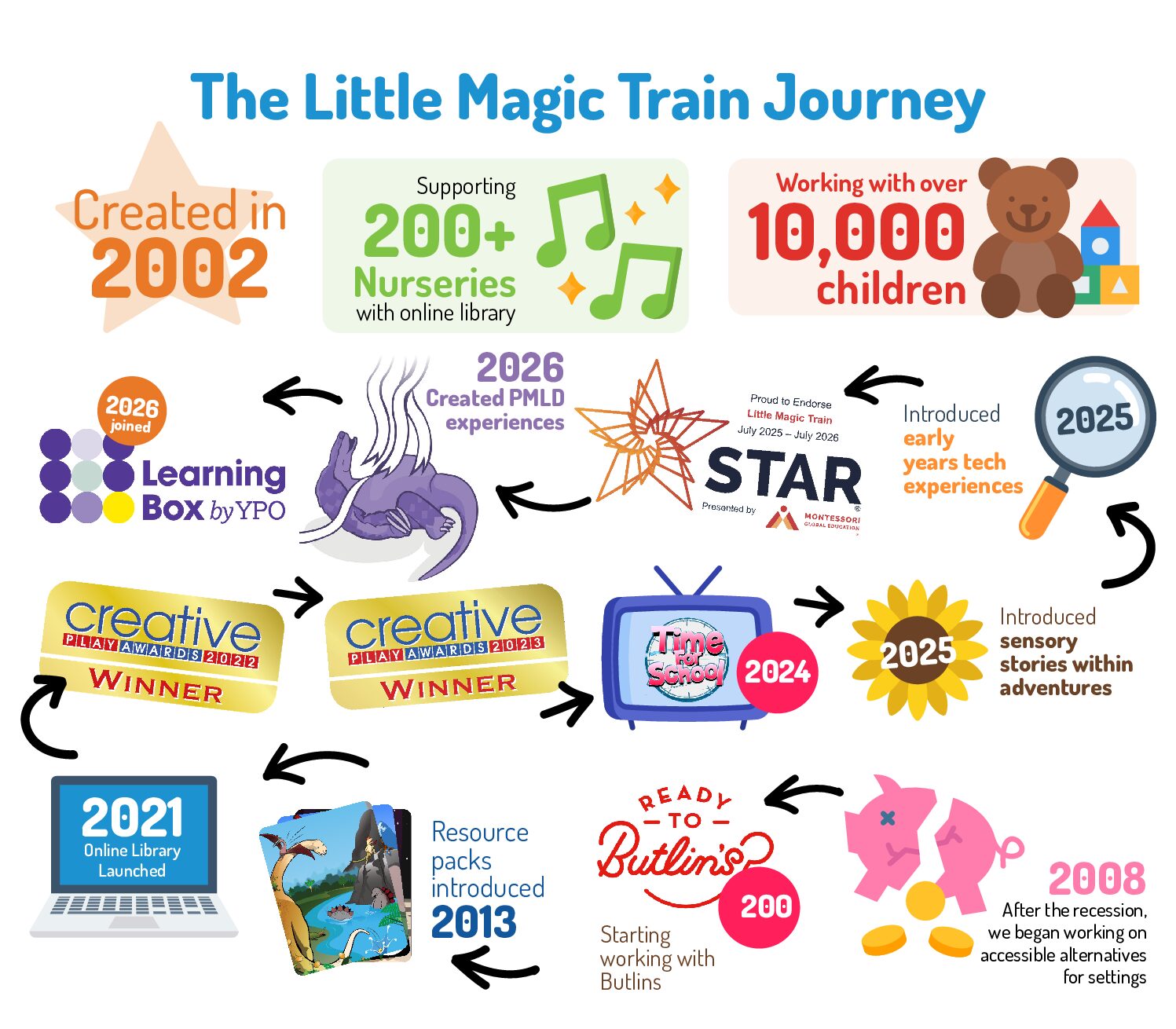
Used in over 200 nurseries and preschools, the programme combines movement, music and storytelling to create inclusive learning experiences that support children across the Early Years Foundation Stage (EYFS).
Practitioners report improved participation, increased language use and greater confidence among children taking part in the adventures.
The programme has evolved over more than two decades and is now delivered through a growing digital library used by early years practitioners across England and Wales.


Easy to implement
Little Magic Train has been designed to be easily implemented across a wide range of early years environments, including nurseries, preschools, reception classes and specialist SEND settings.
The programme is delivered through a structured digital library and practitioner-friendly resources that enable educators to lead multi-sensory storytelling sessions without requiring specialist movement or drama training. This allows settings to integrate the adventures into daily practice while maintaining consistency and quality.
Because the core structure of each adventure remains familiar, children quickly learn the routine while practitioners can adapt the experiences to suit different ages, abilities and learning needs.
This flexible approach allows Little Magic Train to be successfully used in mainstream early years provision, specialist SEND environments and mixed-ability groups, supporting inclusive learning experiences for children across diverse settings.
Across participating settings, 100% of respondents said they would recommend Little Magic Train to other early years settings.
Request a printed impact report to share with your team and explore the real impact of Little Magic Train in early years settings.
Practitioners consistently described Little Magic Train as a valuable and engaging learning experience that supports communication, confidence and participation for a wide range of learners.
Educators highlighted how the adventures capture children’s attention while also supporting speech and language development, imaginative play and social interaction.
Communication
Confidence
Progress
Many settings reported improvements in children’s communication skills, particularly through repeated storytelling, language, and shared imaginative experiences.
New Moston Primary School
“Children really improved in engagement and communication. All the children have really developed in attention during sessions.”
Soar Childcare and Education Ltd
“Those with communication difficulties had excellent repetition and therefore opportunities to practise skills over and over, which is often difficult in a busy day. It offers many chances for differentiation in communication and introducing new vocabulary.”
Practitioners also noted that children began using new words and ideas introduced during the adventures within other areas of learning.
Several practitioners reported that children who were initially hesitant to join group activities became more confident participants over time.
Kennington Pre-School
“Children were more likely to join in with adults and others.”
Wootton and Dry Sandford Preschool
“We have a few children who do not engage in any activity, but when we do the Magic Train, they are fully engaged and join in. Little Magic Train is great for bringing out confidence in shy children.”
Practitioners also observed that children increasingly contributed their own ideas to the storytelling adventures, helping shape the direction of the shared narrative.
Settings shared examples of how individual children developed confidence and communication through repeated participation.
New Moston Primary School
“At the start of the sessions, one of our children joined in for only a few seconds and needed 1:1 adult support. Now he asks for Little Magic Train, sits with his train ready and confidently joins in independently for the whole session.”
Confidential Setting
“One child now comments on what he can see on the journey. We placed pictures of planets around the room and as we pass them he now says ‘I think I can see Saturn’. This child had very little language 1–2 years ago.”
These examples demonstrate how repeated storytelling experiences can support children in building confidence, language and participation over time.
Individual Case Studies
Supporting engagement, outdoor learning and imaginative play
In childminding settings, children often learn across a wide age range, with different interests, developmental stages and levels of confidence. Creating shared experiences that engage younger and older children together all while supporting physical movement, communication, social skills and curiosity, can be a challenge. At Munchkinos Childminding, Little Magic Train became part of their weekly […]

Supporting engagement, inclusion and learning through shared adventures
In many early years settings, practitioners are looking for flexible ways to bring children together through play, movement and imagination while supporting communication, confidence and participation. At Little Peeps, the team wanted resources, training and support to help engage their little ones in the learning process and extend learning across the setting. That is where […]

Supporting communication, participation and confidence within a SEN hub
Challenges in a SEND Provision Supporting children with a wide range of communication needs within a shared learning environment can be complex. Within a confidential setting, a newly established SEN hub was supporting a mixed-age group of 5 children, each with differing communication styles, preferences and developmental needs. At this early stage, staff were still […]

Supporting sustained engagement, deeper play and whole-setting participation
In early years settings, children often show good levels of engagement in imaginative play, but may find it more difficult to extend and develop their ideas within shared experiences. While children may enjoy storytelling and role-play, building on these ideas and sustaining engagement within group activities can present a challenge. At Kennington Pre-School, practitioners were […]

Unlocking group engagement and communication in an early years setting
In many early years settings today, practitioners are seeing a growing challenge. Some children are hesitant to join group activities. Others are finding it difficult to communicate their ideas or engage with peers. For those with additional needs, participation can feel overwhelming – often requiring adult support to access even simple group experiences. At Soar […]

Supporting confidence and participation for quieter children through shared storytelling
In many early years settings, children develop confidence and engagement in group activities at different rates. While some children are naturally confident and enjoy stories and imaginative play, others may be more hesitant, particularly when it comes to joining in with group experiences. Creating opportunities that support all children, including quieter or less confident learners, […]
Supporting engagement, confidence and communication
In many early years settings, practitioners are supporting children at different stages of development within the same environment. Some children are beginning to develop confidence in group activities, while others are still finding their way, particularly when it comes to communication, participation and sharing ideas. Creating opportunities that engage all children, regardless of age or […]

Supporting children with SEND to engage, communicate and participate with confidence
In many early years and primary settings, supporting children with additional needs to engage in group activities can be a significant challenge. Some children may find it difficult to join shared experiences. Others may struggle with communication, attention or confidence within a group. For practitioners, creating opportunities that are inclusive, meaningful and manageable within the […]

Sustained impact over time: building engagement, imagination and adaptability across early years
Early years settings require approaches that can engage children across a wide age range while remaining flexible, sustainable and easy to embed into daily practice. Supporting imaginative play, attention, participation and school readiness skills can be particularly challenging when working with mixed-age groups and evolving cohorts. At Marcham Pre-School, practitioners support children aged from 2 […]

Supporting engagement, imagination, and participation through outdoor storytelling
In early years settings, children develop imaginative play at different stages. Some children begin to explore storytelling and role-play within their own play, while others are still building the confidence to engage in shared imaginative experiences with their peers. Creating opportunities that bring children together in a way that builds on this emerging play, while […]
Practitioner Reflections
Buttercups Montessori Nursery
“At Buttercups Nursery, our children absolutely love Little Magic Train! The imaginative adventures capture their attention from the very start.
The repetition of words and phrases supports speech and language development, and we have seen real progress in children’s confidence to communicate.
The system is easy to use, well organised and makes planning seamless.
Little Magic Train is a truly engaging, fun and educational resource that brings learning to life through movement, storytelling and play.”
School of Play, Manchester
“Outstanding! The Little Magic Train sessions offer great value for money and have added an extra dimension to our Early Years provision.
Gina delivers training with such passion and energy that you can’t help but be inspired to do the same with the children.
I would definitely recommend Little Magic Train.”
Practitioner Insight
“Having first seen Little Magic Train in another setting, I was keen to bring it into our pre-school.
The children found the adventures magical and engaging, and I saw firsthand the impact on children who may otherwise struggle to participate.
The range of resources supports many areas of learning and fits well within our curriculum.
We are keen to develop our own Little Magic Train programme further, having seen the positive impact it can have on children’s engagement and learning.”

For more than two decades, Little Magic Train has supported educators in creating joyful, imaginative learning experiences for children.
From specialist movement sessions to a growing online library used across nurseries, preschools and schools, the programme continues to evolve in response to the needs of children and educators.
At its heart, Little Magic Train remains focused on what matters most: helping every child feel confident, included and excited to learn through movement, storytelling and shared adventures.
As new stories and experiences are developed, the Little Magic Train journey moves forward, supporting children to explore, imagine and learn together.
With Little Magic Train, every child is invited on the journey.